Fixed stars ✧ November 23, 2026
Akrab: star of power, strategy and shadow
Fixed stars between astronomy, history and symbolic interpretation
ACRAB (β SCORPIO): POWER, STRATEGY AND SHADOW
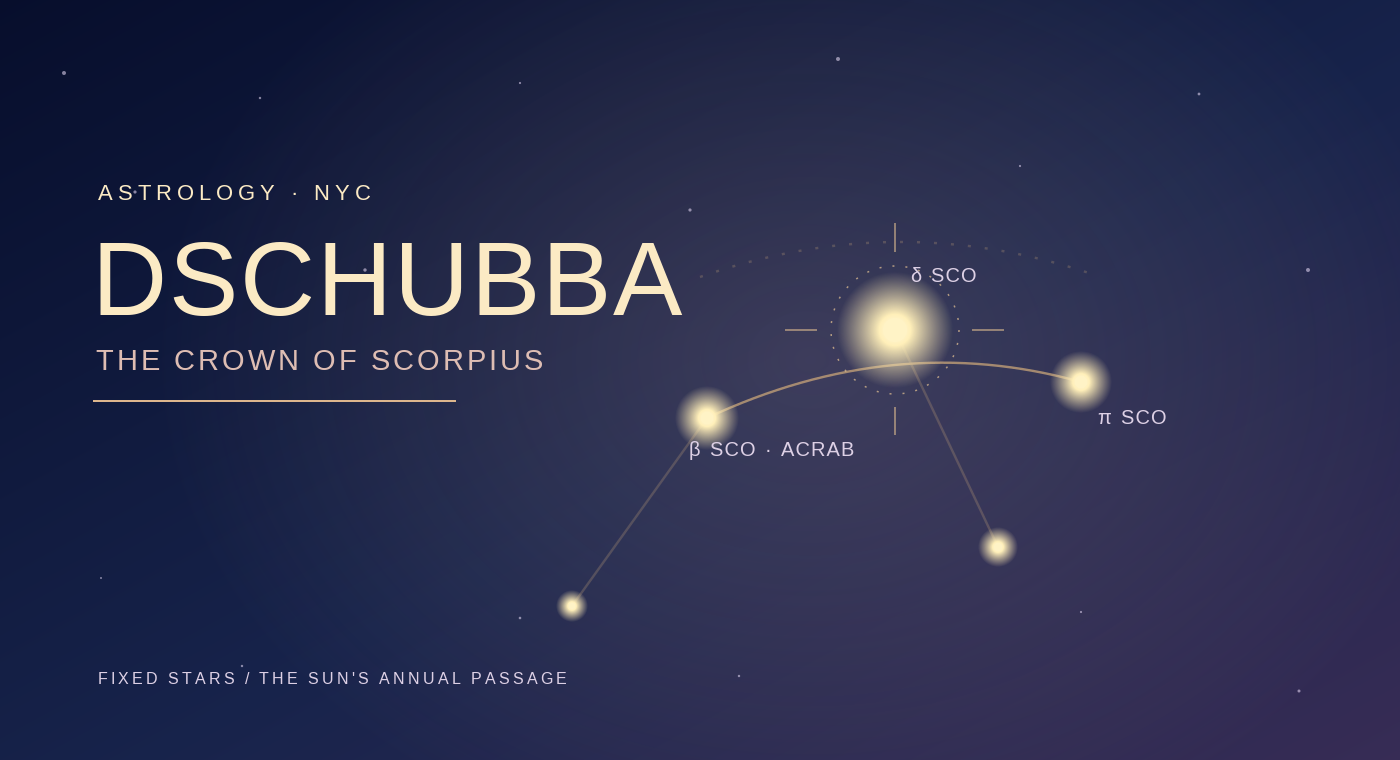
At the end of November, the Sun passes through the tropical longitude of Acraba, a fixed star at the head of the constellation Scorpio. Its name goes back to the Arabic al-ʿaqrab - “Scorpio”. The acrab is also called Graffias; together with Jubba and several neighboring stars, it is associated with the ancient asterism “Crown of Scorpius”.
Where is the Akrab located - in the claw or in the head?
Despite the expressive name, β Scorpio is found in the head of the celestial Scorpio, and not in its claw or tail. Therefore, the image of “conquering one’s own with claws” is a beautiful modern metaphor, but not a literal explanation of the place of a star in the sky. In the tropical zodiac, its longitude in 2026 is about 3° Sagittarius: the constellation Scorpio and the sign of Sagittarius do not contradict each other here, because they belong to different coordinate systems.
Mars and Saturn: not rage, but sustained struggle
In a tradition dating back to Ptolemy, the bright stars on the forehead of Scorpio were attributed to the nature of Mars with an admixture of Saturn. Mars - action, will, struggle; Saturn - time, discipline, calculation and limitations.
What interests me in this symbolism is not the aggressive person who attacks first, but the one who knows how to endure, prepare, defend a position and return to his goal after defeat. The power here is not always loud. Sometimes it is expressed in the ability to wait for the right moment.
Astrologer Eric Morse associated Akrab and Jubba with careful, skillful strategy, research, investigation and the ability to get to the hidden. Elsbeth Ebertin also noted the research abilities of this group of stars, but emphasized the difficulty of its interpretation.
Dark side of Akrab
You cannot leave only the beautiful part of the symbolism. In old treatises, Akrab was credited not only with determination and recognition, but also with suspicion, cunning, cruelty, deception, conflict, the desire for profit, difficult obstacles and losses. Vivian Robson uses particularly harsh language.
However, these are historical judgments of astrologers, and not an established characteristic of a person. A conjunction with a star does not make anyone a criminal or a victim and does not predict illness, violence or disaster.
Can Akrab be called a star of rebirth?
I am close to this interpretation, but it is important to understand that “rebirth” is not its generally accepted classical definition. This is a modern interpretation of the combination of Mars and Saturn: a person is going through a crisis, learning to preserve himself, collecting resources and trying to regain what was lost.
But there is a fork in the road here too. One directs the power to create new life. Another gets stuck in resentment, jealousy or the desire for revenge. I am interested in this very question: what does a person turn his own resilience into?
Tina Turner: a comeback story
According to calculations published on Astrology King, Tina Turner's Sun is conjunct Acrab with an orb of 1°39′. The singer left a destructive marriage and re-conquered the music scene in 1984 with the album Private Dancer. Her story of comeback is especially interesting in the context of our theme - the ability to start again after loss.
This is an example for a symbolic comparison of a biography with an astrological chart, and not proof that it was Akrab who determined her fate.
I would explore first of all close conjunctions with the Sun, Moon, Ascendant and MC, taking into account the exact time of birth for the chart angles, orb, general configuration and real life circumstances. You cannot take out one fixed star from an entire horoscope.
Akrab is interesting to me not because of the promise of inevitable victory, but because of the contrast between two possibilities: to destroy and create, to take revenge and to restore, to lose control and to learn to control oneself.
It is in how a person uses his power that the theme of free will is revealed.
Astrological interpretations of the fixed stars belong to the symbolic tradition; their influence on character and destiny has not been scientifically confirmed.
Sources and further reading
Historical astrological texts and biographical references. These interpretations are not scientific evidence of celestial influence.