Fixed stars ✧ November 22, 2026
The Crown of Scorpius: Dschubba conjunct the Sun
Fixed stars between astronomy, history and symbolic interpretation
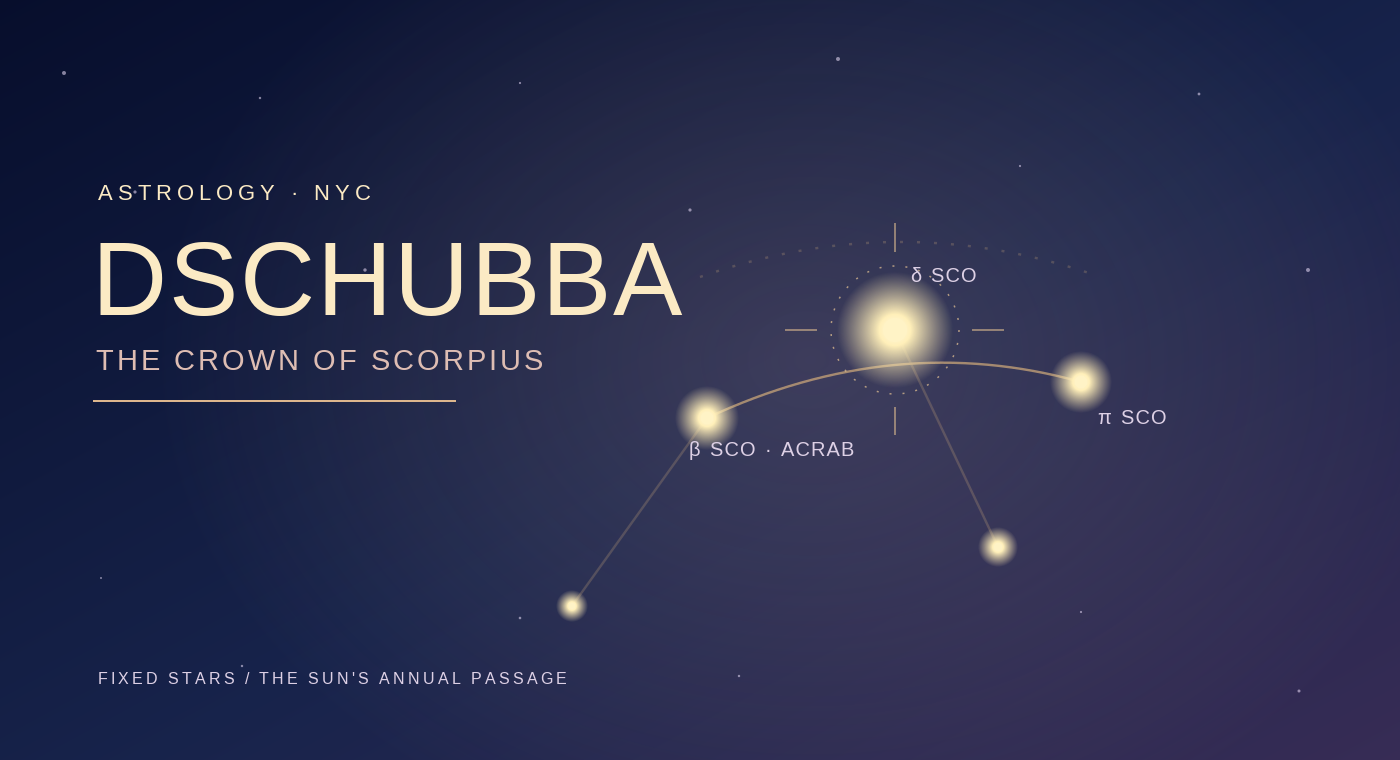
In late November, the Sun reaches the tropical ecliptic longitude of Dschubba (Delta Scorpii). In 2026 the closest longitude conjunction falls around November 25. Why did ancient observers imagine a crown in this part of the Scorpion's head?
A crown upon the Scorpion's forehead
Dschubba means “forehead.” Along with Beta Scorpii (Acrab) and Pi Scorpii, it belongs to the curved grouping historically called Iklil al-Aqrab, the Crown of the Scorpion. This is an asterism, not a separate constellation or Corona Borealis. Different traditions saw the same stars as a crown, a forehead, or a marker in the figure of Scorpius.
Dschubba is a bright, blue-white star in the Delta Scorpii system. Although it belongs to the astronomical constellation Scorpius, its 2026 tropical zodiac longitude is around 2°55′ Sagittarius. Zodiac signs and physical constellations are different systems.
The traditional astrological reading
Ptolemy associated the bright stars of the Scorpion's forehead with Mars and, to a lesser extent, Saturn. In astrological symbolism, that suggests courage, persistence, discipline and tactics, alongside the risks of rigidity, suspicion and struggle for control.
Later authors, including Elsbeth Ebertin, connected Dschubba and Acrab with investigation and interest in what lies hidden. Yet some of these authors also cautioned that the interpretation deserves further study. Other older sources speak about recognition and ambition, while some offer very severe moral judgments. These are historical symbolic attributions, not evidence about anyone's character.
Sun conjunct Dschubba in a birth chart
When interpreted symbolically, a natal Sun–Dschubba conjunction suggests a person motivated to investigate, lead, protect principles and pursue difficult goals. A potential shadow is defensiveness, conflict with authority or excessive need for control. No fixed star can determine a person's morality or fate; the full chart, personal context and actual choices matter.
The Sun's passage around November 25, 2026
Astronomically, the Sun and star share approximately the same ecliptic longitude near 2°55′ Sagittarius. They are not precisely superimposed in the sky: Dschubba lies roughly two degrees south of the ecliptic. The Sun's brightness also makes this an impossible naked-eye daytime pairing.
Astrologically, this annual passage can serve as a reflective prompt: What truth am I seeking? Where should I persist, and where should I become flexible? Is a struggle protecting my values, or merely exhausting me? These are questions, not predictions about world events or individual lives.
Daragan's method and fixed stars
In Astrology of Personal Transformation, Konstantin Daragan discusses conjunctions between fixed stars and planets or significant chart points, as well as the importance of orbs and precession. Those are methodological considerations. We did not find a verified Dschubba-specific interpretation by him in the available material, so we do not attribute one to him.
What people actually say online
Firsthand accounts specifically about the Sun conjunct Dschubba are scarce. In a 2016 Astrology King comment, Cynthia asked about Dschubba on her Sagittarius Ascendant. The author answered cautiously and suggested consulting more recent interpretations. That exchange is a question, not confirmation of an effect.
On a Geocult forum thread, one participant listed Chiron near Yed Prior, Dschubba and Acrab among many other aspects, then described vivid dreams, high ambitions and an interest in research. With so many factors, the role of any individual star cannot be separated. A different historical astrology forum discussion mentioned Dschubba alongside several other chart factors when interpreting Venus and relationships. These are anecdotes about interpretation, not reliable evidence.
Between astronomy and mythology
The Crown of the Scorpion is both a real collection of stars and a cultural metaphor. We can enjoy its ancient stories without treating astrology as a scientifically established influence on life events.
Sources and discussions
Research references, historical interpretations and publicly accessible discussions. Personal accounts are anecdotal, not evidence of causal influence.